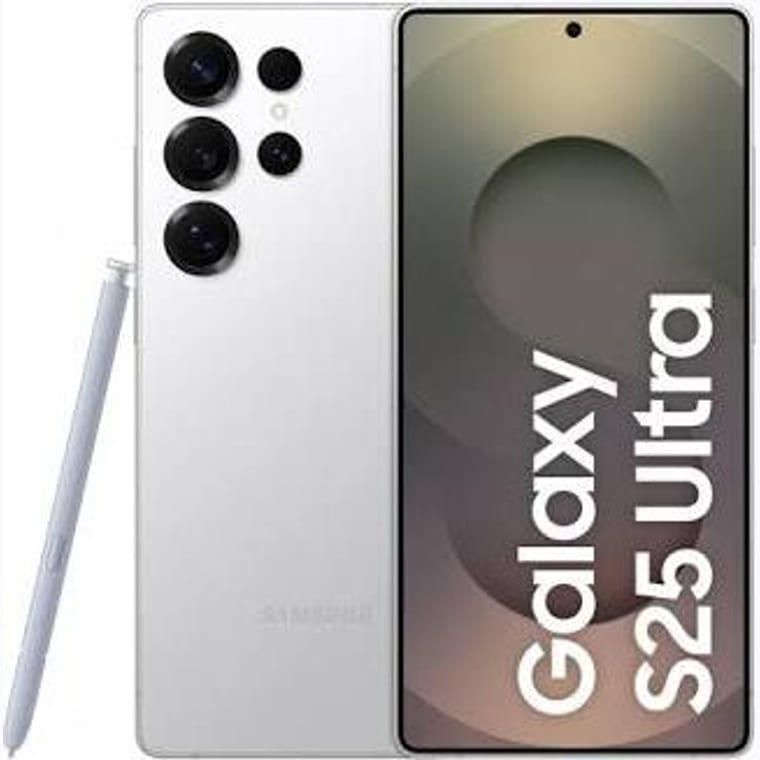
What You Are Actually Paying For
At ₹1,09,999 against a ₹1,29,999 list price, the S25 Ultra is not a phone anyone buys casually. It is worth being precise about where that money goes, because three of its headline features are genuinely unmatched and the rest are merely competitive.
The unmatched three: a built-in S Pen with nowhere else to buy an equivalent, a dedicated 5× periscope alongside a separate 3× telephoto, and seven years of guaranteed OS updates. Nothing else on Android offers all three. Everything else — the chipset, the panel, the build — is excellent but has close rivals at considerably lower prices.
The Display Is the Best Argument for the Price
A 6.9-inch QHD+ Dynamic AMOLED 2X running 1–120Hz adaptive, rated to 2,600 nits peak. The number that matters there is not the resolution, it is the brightness: 2,600 nits is the difference between a screen you can read at noon and one you angle away from the sun.
Gorilla Armor 2 is the quieter upgrade and arguably the more useful one. Samsung's anti-reflective treatment measurably reduces glare rather than simply resisting scratches, which changes how the phone behaves outdoors more than another few hundred nits would.
The adaptive refresh matters for battery rather than smoothness. Dropping to 1Hz on a static screen is what lets a 5,000 mAh cell drive a panel this large and this bright to Samsung's quoted 31 hours of video playback.
Titanium, and What 218 g Feels Like
The titanium frame is real and it is also marketing. It is genuinely stronger than aluminium at the same weight, and at 218 g the S25 Ultra is not light — it is simply lighter than it would otherwise be at this size. Anyone coming from a compact phone should handle one before committing; no spec sheet conveys what a 6.9-inch slab does to one-handed use.
IP68 covers the ordinary accidents. It does not cover salt water, and it is a rating that degrades with age and drops rather than a permanent guarantee.
Cameras: Where 200 MP Is and Is Not the Story
The 200 MP f/1.7 main sensor does not produce 200 MP photos in normal use. It bins groups of pixels into one larger effective pixel, which is why the practical benefit shows up as cleaner low-light images and more cropping headroom rather than enormous files.
The more interesting decision is the two telephotos: 10 MP at 3× and 50 MP at 5×. Most rivals ship one. Having a dedicated 5× means genuine optical reach rather than a crop of the main sensor dressed up as zoom, and the 50 MP sensor on the longer lens is the one that makes distant detail hold together.
Where we will not pretend to certainty: processing decisions — skin tones, how aggressively night mode brightens, video stabilisation in low light — are not visible in a specification and vary between firmware versions. Those need hands-on testing we have not done.
Charging Is the Weak Spot, and It Is Not Close
45W wired and 15W Qi2 wireless. In isolation those are unremarkable numbers. Next to a OnePlus 13 at 100W wired and 50W wireless — on a larger 6,000 mAh battery, at roughly two-thirds the price — they are hard to defend.
This is the single clearest place where the S25 Ultra loses on something you touch every day. Battery life is competitive; the time spent tethered to a wall is not. If you charge overnight and never think about it, this is irrelevant. If you top up before heading out, you will notice it constantly.
Seven Years of Updates Is the Underrated Feature
Seven years of guaranteed OS updates is the longest commitment on Android and it changes the arithmetic of the price. Amortised over seven years the S25 Ultra is cheaper per year than a mid-range phone replaced every three — provided the battery lasts, which after five years it will not without a replacement.
Treat it as a genuine differentiator with an asterisk: software support outlasts hardware, and a battery service at year four is the realistic cost of holding one that long.
Galaxy AI, Honestly
Galaxy AI covers writing assistance, photo editing, call translation and search-by-circle. Some of it runs on the device; some requires a connection. Samsung has stated that some features may require a paid subscription in future, which is a material caveat on a phone bought partly for its AI.
Our position: AI features are a reason to prefer a phone, not a reason to buy one. They change faster than hardware and arrive on rivals within a cycle.
Who Should Buy It
Buy the S25 Ultra if you will use the S Pen, if you photograph things at distance, or if you keep phones for five years or more. Under those conditions there is no direct substitute and the price is rational.
If none of those describe you, the honest recommendation is the OnePlus 13. It matches the chipset, beats the charging, carries a bigger battery, and costs roughly ₹35,000 less. What you give up is the S Pen, the second telephoto, and three years of updates.