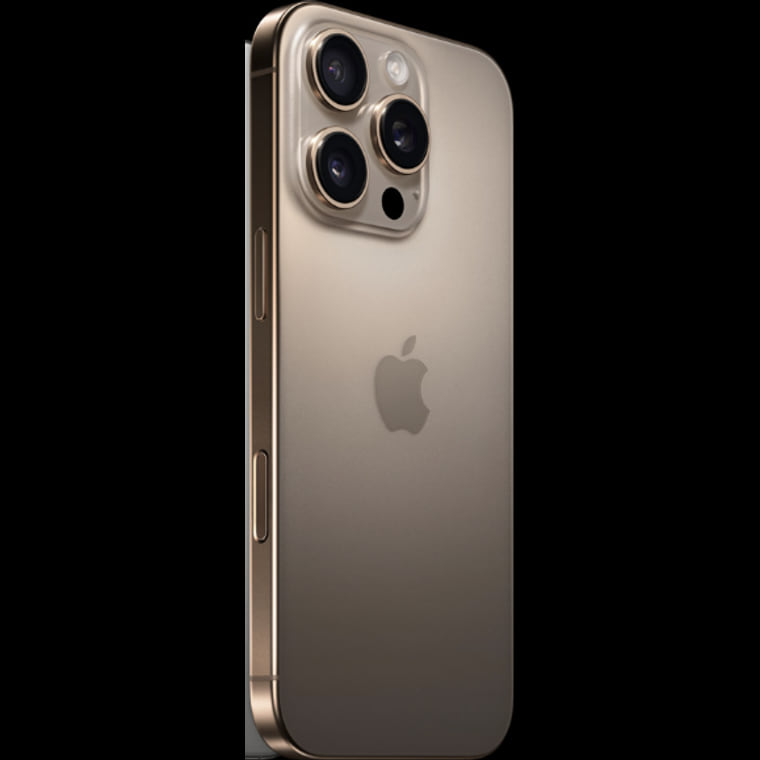
Read This Spec Sheet Carefully
Set against the Android flagships here, the iPhone 16 Pro's numbers look weak. A 3,582 mAh battery against 5,000 and 6,000. 38W charging against 45W and 100W. 8 GB of RAM against 12 and 16. A 2622 × 1206 display against two QHD+ panels. And it costs ₹1,19,900 — more than either.
Those comparisons are accurate and they are also close to meaningless in isolation, for a reason worth understanding rather than hand-waving: iOS and Android manage memory and power differently enough that the same figure means different things. Apple's tighter integration of silicon and software lets 8 GB behave like more, and a smaller battery last longer than the capacity suggests.
This is not a defence of the price. It is a caution against reading the table as a scoreboard.
Size Is the Real Feature
At 6.3 inches the iPhone 16 Pro is the only phone in this group you can comfortably use one-handed, and that is not a small thing — it is the single most-cited reason people choose it.
The market has moved almost entirely to 6.7 inches and above. If you want a current flagship that fits a pocket and reaches its own top corner, the options are close to none. That scarcity, more than any specification, is what the iPhone 16 Pro is selling.
The A18 Pro
Apple's A-series has led single-core performance for several generations and the A18 Pro continues that. For everyday responsiveness the practical difference against a Snapdragon 8 Elite is negligible — both are far beyond what typical use demands.
Where it matters is sustained professional work: video encoding, computational photography, and on-device machine learning. If your phone is a work tool for video, this is the relevant advantage.
Cameras: Fewer Megapixels, Different Priorities
A 48 MP f/1.8 main with OIS, a 48 MP f/2.2 ultrawide, and a 12 MP telephoto at 5× optical. Against a 200 MP Samsung main sensor, 48 MP reads as modest. It is not the useful comparison.
Two things stand out. The ultrawide at 48 MP matches the main sensor's resolution, which historically has not been true of iPhone ultrawides and materially improves that camera. And the telephoto reaches 5× optical — matching the S25 Ultra's longest lens, though with a 12 MP sensor against Samsung's 50 MP, so there is far less room to crop.
The iPhone's genuine camera advantage remains video. That is a consequence of encoding, stabilisation and colour consistency across lenses — none of which appear in a specification table, and none of which we can verify without hands-on testing.
Battery and Charging: The Honest Weakness
3,582 mAh is small in absolute terms, and iOS efficiency genuinely offsets much of the gap. What efficiency cannot offset is charging speed: 38W wired and 25W MagSafe are slow, and no amount of software optimisation refills a battery faster.
Against the OnePlus 13's 100W, this is a daily difference. Fifteen minutes on a charger produces meaningfully different outcomes on the two phones.
Not in our data: we do not hold a verified endurance figure for the iPhone 16 Pro, so we are not going to estimate one. Where Samsung publishes 31 hours of video playback, we have no comparable Apple figure recorded, and inventing a number to fill the row would be worse than leaving it empty.
Satellite Messaging
Our spec data records satellite connectivity for this phone and not for the others in the group. For most buyers this is irrelevant most of the time and then occasionally decisive — hill walking, remote driving, anywhere outside coverage. Availability and terms vary by country and change, so verify for India specifically before treating it as a reason to buy.
The Ecosystem Question
The strongest arguments for this phone are the ones a review of the hardware alone cannot make. If you own an Apple Watch, AirPods and a Mac, the integration is real and switching away costs you working features rather than convenience. iPhones also hold resale value better than Android flagships, which narrows the effective price gap over a three-year hold more than the sticker suggests.
If you own none of those, that entire argument evaporates and you are left with the spec sheet — where this phone does not win.
Who Should Buy It
Buy it if you want a compact flagship, if you shoot video seriously, or if you are already in the Apple ecosystem. Those three cases cover most people who should own this phone, and for them it is comfortably the right choice.
Do not buy it to win a specification argument. It will lose, and the people who love it are not having that argument.