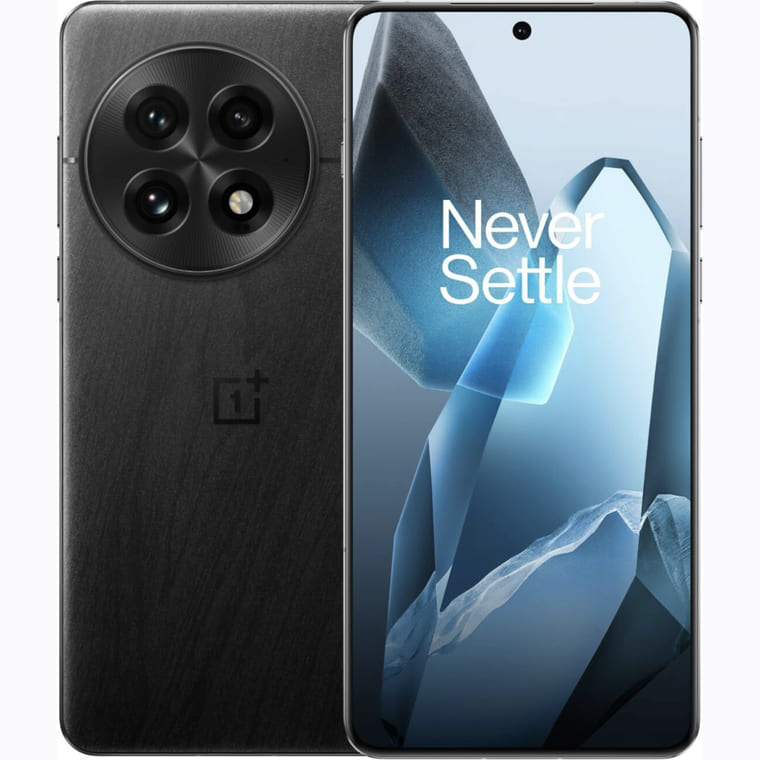
The Value Argument, Stated Plainly
The OnePlus 13 costs ₹74,990 and runs a Snapdragon 8 Elite — the same generation of silicon as the Galaxy S25 Ultra at ₹1,09,999. On raw compute there is no meaningful gap between them. That single fact is the whole argument for this phone, and it is a strong one.
What that money does not buy you is an S Pen, a second telephoto, or seven years of updates. Whether that matters is genuinely personal, and it is the question the rest of this review tries to make answerable.
Charging Is the Headline Feature
100W wired and 50W wireless, into a 6,000 mAh battery. Both halves of that matter and they compound: the battery is the largest here, and it refills faster than rivals fill smaller ones.
The practical effect is a behavioural change rather than a numerical one. At 100W, ten minutes on the charger is a usable top-up, which means you stop planning your day around battery. At 45W it is a partial one; at 25W it is barely worth plugging in. This is the clearest everyday advantage the OnePlus 13 holds over anything else in this price range.
The 50W wireless figure deserves particular attention: it is faster than most rivals manage over a cable. That requires a compatible charger, which is an extra purchase.
The Display Is Quietly Best-in-Class on Paper
A 6.82-inch LTPO OLED at 3168 × 1440 with 1–120Hz adaptive refresh. That resolution is marginally higher than the S25 Ultra's 3120 × 1440, on a panel a fraction smaller — so pixel density is a touch higher, though the difference is invisible at normal viewing distance.
LTPO is the specification that matters. True variable refresh down to 1Hz is what allows a large, high-resolution panel to coexist with genuinely long battery life, and it is the reason the 6,000 mAh cell goes as far as it does.
Not verifiable from a spec sheet: peak brightness is not in our data for this phone, and outdoor legibility is exactly where panels differ most. Treat that as unknown rather than assuming parity with Samsung's 2,600 nits.
Cameras: Strong Sensors, Unproven Processing
A 50 MP f/1.6 main with OIS, a 50 MP f/2.0 ultrawide at 120°, and a 64 MP f/2.6 telephoto at 3× optical. The f/1.6 aperture is the widest in this comparison set, which means more light reaching the sensor and, in principle, better low-light capture.
The 64 MP telephoto is unusually high-resolution for a 3× lens, and that resolution gives real cropping headroom — a 3× lens you can crop into behaves closer to a 5× than the numbers suggest.
The 50 MP ultrawide is the underrated one. Most ultrawides are the weakest camera on the phone by a wide margin; matching the main sensor's resolution suggests OnePlus did not treat it as an afterthought.
What we cannot tell you is how any of this actually renders. Sensor specifications set a ceiling; processing determines whether a phone reaches it. OnePlus's colour science has historically divided opinion, and that is not something a data sheet resolves.
Four Years, Not Seven
Four years of OS updates plus six years of security patches. That is a respectable commitment and it is comfortably short of Samsung's seven.
Be concrete about what this means. Buy this phone in 2026 and it stops receiving new Android versions around 2030, with security patches to 2032. For most people replacing a phone every three to four years, that is entirely sufficient and the shorter window costs you nothing. For anyone who keeps a phone until it dies, it is the strongest reason to spend more elsewhere.
This is the clearest trade in the phone: roughly ₹35,000 saved against three years of OS support.
What Is Missing
No S Pen equivalent, and no second telephoto — a single 3× rather than the 3× plus 5× pairing on the S25 Ultra. Our spec data does not record an IP rating or a satellite messaging capability for this phone, so both should be checked against current OnePlus documentation before you rely on them.
We would rather flag a gap in our data than let an empty row imply the feature is absent.
Who Should Buy It
Buy the OnePlus 13 if you want flagship performance without flagship pricing, if fast charging genuinely changes your day, or if you replace your phone within four years. Under those conditions it is the most sensible purchase in Android.
Spend more only for a specific reason: the S Pen, longer optical zoom, or seven-year support. Those are the three things the extra ₹35,000 buys, and if none of them apply the money is better kept.